
Style Guide · January 2025
The Best Korean
Streetwear Brands to Watch
Korean menswear has gone from niche obsession to global force in about five minutes. These are the labels, from AJOBYAJO's Seoul-subculture streetwear to the early-internet retro-futurism of Ader Error, that are setting the tone for what streetwear looks like right now.
Why Korean Streetwear Matters
A design language built on contradiction.
Korean streetwear doesn't borrow from one tradition, it stitches several together and leaves the seams showing. There's the restraint of Japanese minimalism, the volume of American workwear, the precision of European tailoring, and the graphic punch of Seoul's underground scene, all turning up in a single collection. It feels globally familiar and slightly off in the best possible way.
The rise of K-fashion isn't an accident. Seoul's Dongdaemun district runs on a design-to-rail timeline that Western labels can only dream about. Korean brands test ideas in real time, iterate in weeks, and build cult followings before most fashion weeks have wrapped their after-parties. Speed is one advantage. Cultural fluency is the bigger one. These designers know how to reference Western archetypes without copying them.
At UNDERFOUND, Korean labels have been central to the buy from day one. AJOBYAJO sits alongside our most requested brands, not as a trend play, but because the craft holds up to scrutiny season after season.
The Labels
Six brands shaping the conversation.
Est. 2016
AJOBYAJO
Seoul subculture, '90s NYC energy
AJOBYAJO (아조바이아조) is the label everyone in global streetwear keeps pointing at, and for good reason. Founded in 2016 by Kim Se-Hyung (known to most as Ajo Kim), the brand pulls from '90s New York streetwear and the street art, skate, punk and queer scenes of Seoul. The cuts run oversized and a bit unruly, the graphics carry real attitude, and the palette swings between washed neutrals and the odd shot of acid colour. It feels like a city at night, which is exactly the point.
Signature pieces
Oversized bombers, baggy denim, statement graphics
Est. 2014
Ader Error
Early-internet retro-futurism
Ader Error operates as an anonymous collective rather than a single designer, and you can feel it in the work. Everything carries that early-internet, 80s-meets-future mood: colour-blocked fleece, oversized tailoring, and graphics that look like they were rendered on a CRT monitor at 3am. Playful, slightly chaotic, very Seoul.
Signature pieces
Oversized blazers, patchwork denim, retro sportswear
Est. 2010
thisisneverthat
Global streetwear, Seoul filter
Founded in 2010 by three friends (Nadan Cho, Jonkyu Choi and Inwook Park) who'd absorbed streetwear in London and New York before bringing it home, thisisneverthat reads like a Korean love letter to the broader streetwear canon. Washed cottons, heavy graphics, silhouettes pitched somewhere between 90s NYC and contemporary Seoul. Often compared to Supreme, but with a calmer, more considered hand.
Signature pieces
Washed hoodies, graphic tees, relaxed cargos
Est. 2014
Andersson Bell
Scandinavian-Korean hybrid
Launched in Seoul in 2014, Andersson Bell stitches together two design cultures that both prize simplicity but get there by very different routes. The name itself is a mash-up: Andersson, a typical Swedish surname, and Bell, a nod to Korean tradition. The result is clean tailoring with unexpected volume, neutral palettes with sudden textural shifts, and a calm confidence that reads as luxury without trying too hard.
Signature pieces
Relaxed tailoring, texture-heavy knits, minimal outerwear
Est. 2002
WooYoungMi
Refined avant-garde
Launched in Paris in 2002 by designer Woo Young-mi, WOOYOUNGMI was one of the first Korean menswear labels to plant a flag at Paris Fashion Week, and it still shows there every season. The work sits at the grown-up end of the spectrum: sculptural tailoring, architectural silhouettes, and a balance between drama and actual wearability that's hard to fake.
Signature pieces
Sculptural coats, precise tailoring, monochrome palettes
Est. 2014
IISE
Traditional craft, modern form
IISE (이세) literally means 'second generation', a nod to founders Terrence (TK) and Kevin Kim, Korean-American brothers who relocated to Seoul to reinterpret Korean craft for a contemporary audience. They work with local artisans on bags, accessories and garments built around traditional techniques (organic dyeing using onion peels, rust and twigs sits at the heart of the brand) reshaped into modern silhouettes. Cultural preservation, but make it streetwear.
Signature pieces
Hand-dyed canvas bags, natural-fabric outerwear, artisan accessories
Brand Focus
AJOBYAJO: Seoul, after dark
Of all the Korean labels we stock, AJOBYAJO is the one that rewards the closest look. Founder Kim Se-Hyung (everyone just calls him Ajo Kim) built the label in 2016 around the streets, clubs and skate spots of Seoul, with one eye permanently on '90s New York. The result is streetwear that feels pulled from a specific city at a specific time of night.
The references run deep into Seoul's subcultures: street art, skate, punk, the city's queer nightlife. You see it in the graphics, in the way the bombers and outerwear get oversized and reworked, in the denim that always looks a season or two lived-in. There's an attitude to the clothes that international brands keep trying to manufacture and never quite land.
The palette mostly stays in washed neutrals (charcoal, slate, bone, faded black) with the occasional sharp hit of acid colour to break things up. These are clothes designed to be worn hard, not folded onto a shelf. The distressing is real, not printed. The graphics earn their place. That's the whole point.
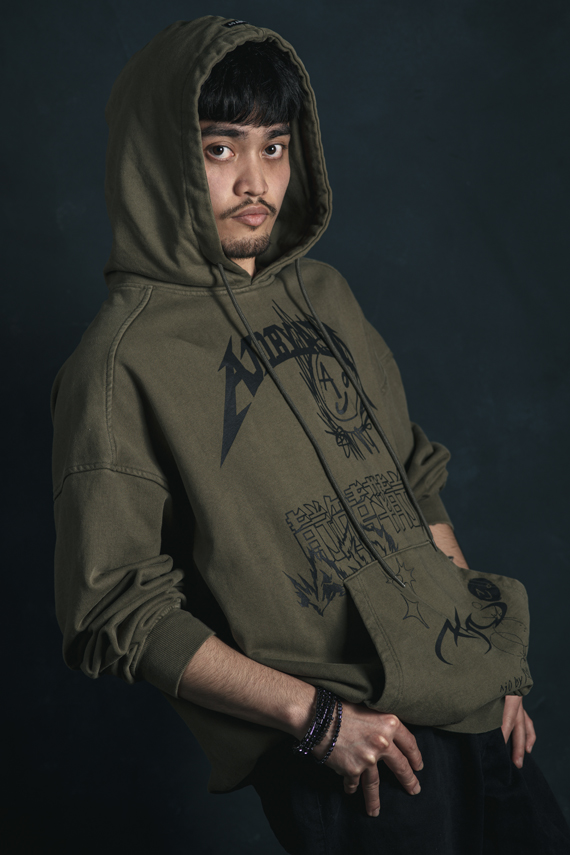
AJOBYAJO - oversized graphic hoodie, AW collection
Styling Notes
How to wear Korean streetwear.
Embrace volume
Korean cuts run oversized by design. Don't size down. The silhouette is the statement. Pair wide trousers with a cropped jacket, or an oversized shirt with slim boots.
Layer with intention
Asymmetry and unexpected lengths are part of the language. A longline tee under a cropped work jacket, or a draped shirt over a turtleneck. The contrast in proportion is what makes it interesting.
Neutral base, single accent
Most Korean streetwear lives in a muted range. Build your base in charcoal, stone, and black, then introduce one piece with texture or a restrained pop of colour.
Mix formality
The Korean approach often pairs tailoring with sportswear or workwear. A structured blazer with technical cargos, or a formal coat thrown over a hoodie. The friction is the point.
Footwear grounds it
Chunky sneakers, derby boots, or minimalist runners all work. The key is proportion. The shoe should balance the volume of the clothing, not fight with it.
Let the details show
Raw hems, exposed seams, asymmetric closures. These are features, not flaws. Don't iron them into submission. The unfinished quality is part of the language.
UNDERFOUND
Shop the Korean edit.
We've pulled our full Korean label selection (AJOBYAJO, Ader Error, thisisneverthat and friends) into a single collection. New arrivals drop weekly.
Heavy Pencil
More stories from the UNDERFOUND studio.